


How Trivandrum Businesses Can Generate More Leads Online
For a clinic in Pattom, a homestay near Kovalam, a coaching centre in Kazhakuttam or a growing company close to Technopark, the next customer may already be looking online. They could be comparing reviews on Google Maps, asking a friend for a WhatsApp recommendation, searching for a service in Thiruvananthapuram, or watching a short video while waiting for a bus. The opportunity is real, but attention alone does not create business. A lead appears when the right person finds you, understands why you are a good fit, and has an easy way to take the next step.
That is the work of online lead generation: connecting useful visibility with a clear, trustworthy path to contact. It is not one advertisement, one viral post, or a website full of keywords. It is a system. Search, maps, helpful content, paid campaigns, referrals, WhatsApp and a well-designed landing page each play a part. The right mix depends on what you sell, who needs it and how quickly they decide.
This guide explains how businesses and service providers in Trivandrum can build that system. It uses local context from Technopark and Kazhakuttam to Pattom, Kovalam and the city centre, and turns the research report’s channel recommendations into practical steps. It also covers how to measure qualified enquiries, what to do in the first 90 days, and how a founder-led studio such as ADTAUR can help when you want a thoughtful partner.
What counts as a lead for a Trivandrum business?
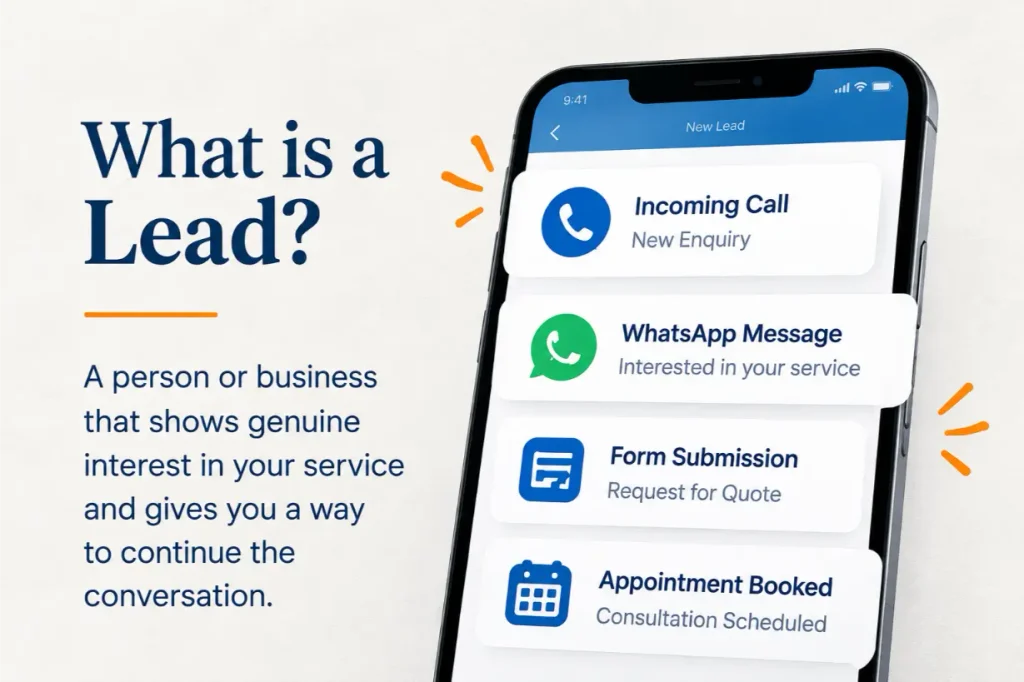
A lead is a person or organisation that has shown interest and given you a way to continue the conversation. For one business, that might be a phone call asking about an appointment. For another, it may be a WhatsApp message about room availability, a request for a quotation, a consultation booking or a form from a company looking for a service provider.
Not every click is a lead. A person who reads a blog post and leaves may be learning; someone who asks whether your clinic accepts new patients has taken a more direct step. Both interactions can matter, but they belong at different stages. Treating every website visit as a lead makes results look larger while making business decisions less useful.
Before investing in marketing, decide what you want to count. Choose one or more actions that represent genuine interest, such as:
-
- A completed enquiry form with a valid phone number or email address.
-
- A call that lasts long enough to discuss the service.
-
- A WhatsApp conversation that reaches a clear question or request.
-
- A booked appointment, site visit, product demo or consultation.
-
- A quotation request from a buyer who fits your service area and offer.
Then distinguish the lead from the sale. A lead is an opportunity; it is not automatically a new customer. Your team still needs to reply promptly, ask sensible questions, explain the offer clearly and follow up. Marketing can bring a prospect to the door. A good sales or service experience helps them step inside.
Why local lead generation matters in Thiruvananthapuram
Thiruvananthapuram—often called Trivandrum—is Kerala’s capital and a city with a varied local economy. The research report points to information technology, education, healthcare, tourism, public administration, manufacturing and research as important parts of the wider district economy. It identifies Technopark, with its concentration of IT companies, as a major business hub. These sectors create different needs: a technology company may look for a dependable B2B partner, while a visitor planning a Kovalam stay may want clear prices and quick availability.
The report also describes a highly literate, mobile-oriented audience that compares services online and values reviews. That makes digital visibility useful across the city, but it does not mean every resident is a prospect for every business. A dental clinic in Pattom does not need enquiries from someone who cannot reach it. A tour operator serving Kovalam may want to reach visitors before they arrive, as well as residents planning a weekend break. A training provider near Kazhakuttam may serve students and working professionals with different schedules and questions.
Local intent is often specific. Someone may search for “physiotherapist near Pattom,” “digital marketing company in Trivandrum,” “family stay near Kovalam Beach,” or “IELTS coaching Kazhakuttam.” The words change, but the need is clear: the searcher wants a relevant option nearby or one that serves the area. Your website and business profile should make that connection obvious.
Local relevance is not a trick of inserting neighbourhood names into every paragraph. It means explaining where you work, whom you serve, what customers can expect, how to reach you and why your service fits their situation. Mention Technopark when you genuinely serve companies there. Explain parking or appointment access if it helps someone visiting your Pattom office. Describe the seasonality of a Kovalam stay if you operate in tourism. Useful context earns trust; a list of place names does not.
Start with the customer, not the channel
Before choosing Google Ads, Instagram, SEO or a directory, describe your best-fit customer. A local business often serves more than one audience, but each campaign should speak clearly to one of them.
Write down:
-
- Who is looking? A homeowner, parent, visitor, patient, business owner, student or procurement manager?
-
- What are they trying to solve? Be specific. “Needs a service” is vague; “needs a reliable electrician for an urgent repair in Kazhakuttam” is actionable.
-
- Where are they? Define realistic service areas: the city, selected neighbourhoods, Kerala-wide, or a visitor market that begins outside the state.
-
- What makes the decision feel risky? Price uncertainty, credentials, response time, quality, safety, availability or fear of choosing the wrong provider?
-
- What proof would help? Reviews, photographs, qualifications, a clear process, before-and-after examples, case studies or a direct conversation.
-
- What is the simplest next step? Call, message, book, request a quote, visit a showroom or download a useful guide?
These answers shape the message. A parent comparing coaching centres wants to know which classes are offered, how enrolment works and where the centre is. A hotel guest may need room photographs, cancellation details and a fast answer about dates. A company near Technopark may want evidence that you can handle a business requirement, not a generic promise to “grow online.”
Create a one-sentence value proposition: “We help [specific customer] achieve [useful outcome] through [service or approach] in [area].” It does not need to appear verbatim on every page. Its purpose is to keep your website, ads and sales conversations focused on the same customer problem.

Build a trustworthy online foundation
Lead generation becomes expensive when the business looks difficult to verify. Before paying for traffic, check that your core details match everywhere and that a new visitor can understand the offer without searching through several pages.
Make the website answer practical questions
Your website should quickly explain what you do, whom you serve, where you operate, what a customer should do next, and how to contact you. A visitor should not need to guess whether you serve Trivandrum, whether you accept new bookings or whether the listed phone number is current.
Useful basics include:
-
- A clear service page for each major offer, rather than one page trying to describe everything.
-
- A contact page with a working phone number, WhatsApp option, email address, opening hours and directions where relevant.
-
- Location and service-area information written in natural language.
-
- Real photographs, team details, credentials and customer proof that you have permission to publish.
-
- A mobile-friendly layout, readable type, fast-loading images and buttons that are easy to tap.
-
- A privacy notice explaining how enquiry information is used, especially if you collect sensitive details.
-
- A visible next step on every important page: call, enquire, book, visit or request a quote.
Keep claims specific and supportable. “We provide same-day appointments when available” is clearer than “the best service in Kerala.” If you promise a response time, make sure you can meet it. Trust is built in the gap between what a page promises and what a person experiences.
Check the enquiry path yourself
Open the site on a phone, as a customer would. Can you understand the offer in a few seconds? Does the call button work? Does the form submit? Does the confirmation tell you what happens next? Does the WhatsApp link open the right business account? Try once on mobile data and once on Wi-Fi. A beautiful page that hides its contact details or breaks on a phone will lose opportunities.
Use a short form. For many local services, name, phone or email, and a brief description are enough to start. Ask for details you actually need, and collect more information later in the conversation. Each extra field asks the visitor to spend time and share more personal information.
Win local search with Google Business Profile
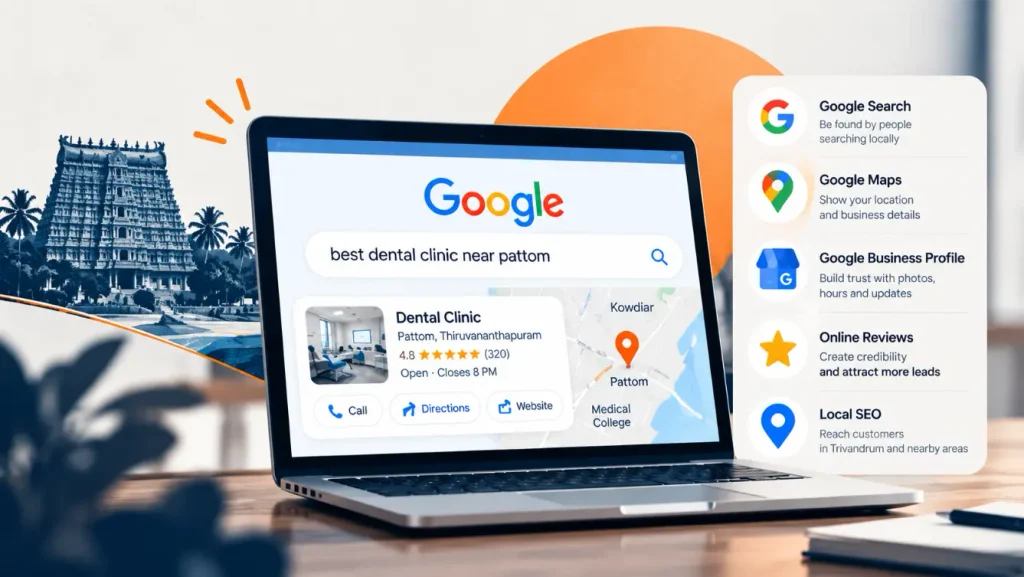
Google Business Profile (GBP), formerly known as Google My Business, is a free business listing that can appear in Google Search and Maps. For a shop, clinic, hotel, training centre or service provider with a local presence, it can be one of the most direct ways to help nearby customers find accurate information.
Complete the profile carefully:
-
- Claim and verify the correct listing.
-
- Use the real business name customers know. Do not add extra keywords to the name field.
-
- Select the closest-fit primary category and relevant additional categories.
-
- Keep address, phone, website, hours and service areas accurate.
-
- Add current photographs of your premises, team, services or products.
-
- Describe your services plainly and add useful booking or enquiry links.
-
- Answer questions and update special hours when your schedule changes.
-
- Review the profile regularly so that customer-facing information remains current.
For example, a clinic in Pattom should make its location and appointment route easy to understand. A business serving customers around Kazhakuttam may explain its service area and how to contact the team. A Kovalam property can use genuine room and property photographs that help visitors assess the stay. A studio working with companies near Technopark can state its business services and the areas it serves.
Reviews are an important part of the decision, but they need an honest process. Ask all satisfied customers for feedback without pressure. Do not buy reviews, offer rewards in exchange for positive ratings, or write reviews for customers. Reply calmly and professionally to critical feedback. Avoid sharing private customer details in a public response. A thoughtful response can show future customers that you take concerns seriously.
Post updates only when you have something useful to share: a schedule change, seasonal offer, new service, event or practical announcement. A post mentioning Attukal Pongala or Onam makes sense when it connects to a real offer, opening-hour change or helpful seasonal service. Local references should help the reader, not serve as decoration.
Local SEO: help the right people find you
Local SEO is the work of making a business easier to discover in relevant local searches. It includes your website, business profile, citations, reviews, local content and the quality of your online reputation. A local SEO programme takes sustained effort; it is not a guaranteed shortcut to the top of Google.
Use the language customers actually use
The research report recommends using “Trivandrum” and “Thiruvananthapuram” interchangeably where appropriate. Both forms can appear naturally in the site, because customers may search with either. Add relevant neighbourhood names only on pages that genuinely relate to them. A page about service in Pattom should explain that service; it should not simply repeat “Pattom” in every heading.
The report’s high-intent keyword examples include “SEO services Thiruvananthapuram,” “digital marketing Trivandrum,” “local SEO Trivandrum,” “web development Thiruvananthapuram,” “lead generation company Trivandrum,” and “WhatsApp marketing Kerala.” These are useful starting points for a marketing studio, but they are not universal keywords for every business. A clinic, a home service provider and a resort need different search themes.
Group keyword ideas by intent:
| Search intent | Example pattern | Useful page or action |
|---|---|---|
| Ready to contact | “[service] in Trivandrum,” “near me,” “book [service]” | Service or location page with call and booking options |
| Comparing providers | “best [service] Thiruvananthapuram,” “[service] reviews” | Proof-rich service page, testimonials and clear process |
| Learning first | “how to choose [service],” “cost of [service] in Kerala” | Helpful guide that answers the question and offers next steps |
| Brand or place specific | “service near Technopark,” “hotel near Kovalam” | Accurate local page with directions, availability and details |
Do not force every phrase onto one page. Give each important service a page that answers its audience’s questions. Use the title, page heading and description to explain the topic plainly. Write for a person first; clear language also helps search engines and answer systems understand the page.
Keep business details consistent
The report recommends local listings such as Justdial, Sulekha, IndiaMART, Practo for healthcare and relevant industry directories. It also mentions networks and directories connected to Kerala and Trivandrum. Choose platforms that fit your category and that you can maintain. A relevant, accurate listing is more useful than dozens of stale entries.
Keep your name, address and phone number consistent. Decide how you will display “Trivandrum” or “Thiruvananthapuram” in the business description and location pages, while preserving the exact real business address and name. Correct duplicates and outdated phone numbers where possible. Do not pay for a premium directory package until you know whether it sends suitable enquiries and how those leads are counted.
Create local pages with a real purpose
If you serve distinct areas, a location page can explain what customers in that area need to know: the service available, coverage, travel arrangements, opening hours, relevant examples and how to enquire. Avoid mass-producing near-identical pages where only the neighbourhood name changes. Thin pages can frustrate readers and do little for search visibility.
Local content can also connect your expertise to real events and places. A tourism business might explain practical planning around Kovalam. A retailer may share useful seasonal guidance before Onam. A local service provider may publish opening arrangements during Attukal Pongala if the event affects travel or access. A business with a genuine connection to Padmanabhaswamy Temple can provide visitor information without implying endorsement. Relevance and accuracy matter more than the number of landmarks named.
Earn local links through useful participation
Links from relevant, trusted websites can help people discover your business and can support your authority. The report suggests community events, business associations, educational partnerships, local news coverage, tourism networks and Kerala-based creators as possible opportunities. Treat these as relationship-building ideas, not a checklist for buying backlinks.
Offer a useful contribution: speak at a local business event, share practical expertise with a community group, collaborate on a relevant guide, support an event whose audience fits your service, or provide a journalist with a genuinely newsworthy update. Ask that partners link to the page that helps their readers. Avoid paid link schemes and irrelevant guest posts created only to manipulate rankings.
Use content to answer the questions behind a search
Useful content lowers uncertainty. A person considering a service may want to know how it works, what to prepare, which option fits, what affects the price, and what happens after they enquire. Answering these questions can attract organic visitors and make sales conversations easier.
Good local content ideas from the research report include a guide to local SEO for Trivandrum businesses, a Google Business Profile walkthrough, WhatsApp best practices for Kerala businesses, advice on choosing a digital marketing agency, local link building, Google Ads optimisation, and a 90-day marketing plan. Adapt the underlying idea to your own industry. A clinic might explain how to prepare for a first appointment. A training centre can describe course choices and enrolment. A hotel near Kovalam can answer transport and booking questions.
Use a simple content brief:
-
- Audience: Who is this for?
-
- Question: What exact problem are they trying to solve?
-
- Answer: What can you explain clearly from experience or reliable evidence?
-
- Local angle: Does Trivandrum, Kerala, a neighbourhood or a local season change the answer?
-
- Proof: Can you show a process, photograph, customer story with permission, credential or source?
-
- Next step: What should the reader do if they need help?
Do not publish a fictional case study as if it were real. If you use an illustrative example, label it as an example. Do not promise a ranking, lead volume or revenue increase without evidence. Honest content can still be persuasive: show the work, explain the choices and make a relevant offer.
Google Ads: reach people who are ready to act
Google Search Ads can give a business immediate visibility for selected searches. They are most useful when the searcher already has a clear need and the business can respond to new enquiries. Unlike SEO, paid ads can start bringing visits soon after launch, but they stop when the budget stops and results depend on campaign quality, competition and the offer.
Start narrow. Choose a small group of high-intent searches related to one service and one service area. For a local plumber, “emergency plumber Kazhakuttam” may show stronger intent than a broad term such as “home improvement.” For a studio, the report’s terms “digital marketing Trivandrum” or “lead generation services Kerala” may be relevant if those services are genuinely offered. Add negative keywords to reduce irrelevant clicks, and review search terms regularly.
The report gives indicative planning ranges: small local Google Ads campaigns may begin around ₹10,000–₹20,000 per month, with typical service CPCs varying widely. It notes examples of roughly ₹5–₹20 for simpler local searches and ₹50 or more for competitive professional services, while many service terms may fall around ₹10–₹30. These are not current quotes or guarantees; actual costs depend on the keyword, industry, season, location and auction. Treat them as starting assumptions to verify in your own account.
Your ad should match the page it sends people to. If an ad promises a consultation, the landing page should explain the consultation and make booking easy. If you promote a seasonal stay near Kovalam, show accurate dates, terms, photographs and a clear availability route. Do not send every ad to the homepage and expect visitors to find the offer themselves.
Set a daily or monthly limit you can afford to learn from. Track calls, forms and qualified WhatsApp conversations rather than clicks alone. Review cost per qualified lead and how many leads become customers. A campaign with a lower cost per click can still be poor value if it attracts the wrong people.
Social ads: create demand and stay visible
Facebook and Instagram ads can introduce a product, service, event or offer to people in a defined area or audience. The research report notes that social campaigns can support promotions and visual storytelling, while generally reaching people with lower immediate intent than a search for a provider. This is why social ads often work best with a clear creative idea, a useful offer and a follow-up path.
For a local business, the creative can be simple and specific: a short video of the team explaining a service, photographs of a real product, a useful customer question answered on camera, or an event announcement with the date and location. Malayalam or English may fit depending on your audience. Use subtitles for video where possible, and make the first few seconds understandable without sound.
The report offers indicative social lead cost ranges of ₹50–₹150 per lead and engagement costs around ₹5–₹15, but results vary significantly by audience, industry, creative, offer and lead quality. These are planning figures, not promises. Test one audience and message at a time, and check whether the resulting conversations are relevant. A low-cost form submission is not useful if the person did not understand what they requested.
Use social platforms for awareness, proof, event promotion and retargeting where appropriate. Follow platform rules, respect consent and avoid making sensitive or misleading claims. If a lead form collects personal details, explain what the person is signing up for and how your team will contact them.
WhatsApp: make the conversation easy
WhatsApp is familiar to many Kerala customers, and it can make enquiries feel direct. WhatsApp Business can help a small team show basic business information, organise chats, share a catalogue where relevant and send simple replies. It is especially useful when customers need a quick answer before booking or visiting.
Make the path convenient without turning it into spam:
-
- Use a business profile with accurate hours, description and contact details.
-
- Add a WhatsApp button to the website and relevant ads.
-
- Set a concise greeting that explains when a person can expect a reply.
-
- Use labels to organise enquiries by stage, such as new, quoted, booked or follow-up.
-
- Ask permission before sending promotional messages and honour opt-out requests.
-
- Keep broadcasts useful and occasional; do not add people to groups without consent.
-
- Record the lead source so you can tell whether WhatsApp is helping.
The research report describes the basic Business app as free and notes that business messaging API providers may charge per message, with example costs around ₹0.5–₹1. Provider pricing and rules can change, so check current terms before adopting an API. For many small businesses, the main cost is staff time: every message creates an expectation of a reply.
A good auto-reply is honest. “Thanks for messaging ADTAUR. We usually reply during business hours. Please share your website and the main service you want to grow” is more useful than pretending a person is available instantly. For healthcare and other sensitive services, use care with personal information and move detailed discussions to an appropriate channel.
Referrals, reviews and local partnerships
In a community where people often ask friends and colleagues for recommendations, referrals can bring high-trust enquiries. A referral system does not need to be complicated. Ask happy customers if they know someone who may benefit, make it easy to share your contact details, and thank people appropriately. If you offer a reward, state the terms clearly and never make it conditional on a positive public review.
Partnerships can extend your reach to a relevant audience. A fitness studio might work with a nutrition professional; a homestay could coordinate with a local tour operator; a B2B provider may collaborate with a complementary company serving businesses near Technopark. The partnership should benefit both audiences. Agree on how enquiries will be handled and tracked before launching a joint offer.
Local events can create useful visibility if there is a genuine fit. A workshop, community activity or event around Onam or Attukal Pongala may help a business meet people, but sponsorship alone does not guarantee leads. Give attendees a helpful reason to remember you: a practical demonstration, a useful resource, an appointment offer or a clear follow-up option.
Directories and marketplaces: use them selectively
Directories such as Justdial, Sulekha, IndiaMART, Practo and Urban Company can help certain businesses appear where customers are already comparing providers. Their fit varies by industry. A medical practice may evaluate healthcare listings; a home service provider may consider a service marketplace; a manufacturer may find a B2B directory more relevant than a consumer app.
The research report notes that basic listings may be free while premium listings, paid lead features or commissions can add cost. Its planning ranges include roughly ₹5,000–₹20,000 per month for some premium visibility and ₹5,000–₹15,000 for selective small-business directory budgets. These are examples from the report, not fixed platform prices. Confirm current pricing, lead ownership, refund rules and cancellation terms directly with each provider.
Test one platform before committing to several. Ask how a lead is defined, whether the same enquiry is sold to multiple providers, what location targeting is available, and how you can export or track contacts. Compare qualified leads and resulting sales, not just the dashboard’s total enquiry count.
Design landing pages that turn interest into action
A landing page is a focused page designed around a particular service, audience or campaign. It should keep the promise made in the ad or search result and make the next step clear. It does not need to be long. It needs to answer the questions that would otherwise stop someone from contacting you.
A practical page structure:
-
- Headline: State the service and relevant area or audience.
-
- Short explanation: Say what the customer gets and what problem you solve.
-
- Proof: Use accurate reviews, qualifications, client examples or photographs.
-
- Process: Explain what happens after the person calls, books or submits the form.
-
- Service details: Include the information needed to assess fit, such as coverage, appointment type or inclusions.
-
- Call to action: Offer one primary action, such as “Request a consultation” or “Check availability.”
-
- Contact alternatives: Add a phone or WhatsApp option for people who prefer to talk.
-
- Confirmation: After submission, tell the person that the enquiry was received and what happens next.
Keep forms short, make buttons easy to tap and remove unnecessary distractions. A visitor who clicks an ad for “local SEO in Trivandrum” should land on a page about that service, not a page where the relevant details are buried among unrelated offers. Use local imagery only when it is authentic and useful. A photo of Padmanabhaswamy Temple does not prove a service is good; a real team photo or local customer example may be more relevant.
Conversion rate optimisation (CRO) means improving the proportion of visitors who take the intended action. Start by watching where people leave: do they arrive but not scroll, open the form but not submit, tap the phone number, or ask the same question repeatedly? Fix the largest point of confusion first. Test one change at a time when you have enough traffic to learn from it. Do not celebrate a button-colour test if the page still has an unclear offer.
AEO and GEO: make useful answers easy to understand
Answer Engine Optimisation (AEO) and Generative Engine Optimisation (GEO) describe efforts to make information clear and useful in answer-focused search experiences, including AI-generated responses. The labels are still evolving, and no business can guarantee that an AI system will cite a page. The sensible foundation is to publish original, accurate information that directly answers customer questions.
Use descriptive headings, concise explanations, accurate business details, author or organisation context and evidence for claims. Write FAQ answers in plain language. Keep service pages consistent with your business profile and other trusted sources. Explain local terms where a reader outside Trivandrum may need context. For example, a guide can identify Kazhakuttam as an area near Technopark if that is relevant to the service being discussed.
Avoid writing content solely to satisfy a guessed AI algorithm. If a page gives a clear answer, supports its claims and helps a real customer make a decision, it is useful regardless of which search interface surfaces it. Track referral traffic and enquiries where your analytics setup permits, but do not mistake impressions in an answer interface for qualified leads.
Measure what becomes a customer
Without measurement, it is easy to spend money on the channel that looks busiest rather than the one that produces valuable enquiries. Begin with a small, consistent system.
Set up basic measurement
-
- Google Search Console: Verify your website and monitor search impressions, clicks, pages and query themes. Check whether important pages are indexed and watch for technical issues.
-
- Google Analytics 4: Track useful actions such as form submissions, calls, booking clicks and WhatsApp clicks. Keep event names consistent.
-
- Campaign tags: Add UTM parameters to links in Google Ads, social campaigns, email and partnerships so you can identify the source and campaign.
-
- Lead log or CRM: Record date, source, service requested, area, lead quality, response time, outcome and revenue where practical.
-
- Call tracking: If calls are a major lead channel, use a suitable call-tracking approach and disclose recording or tracking where required. Confirm local legal and privacy requirements for your business.
-
- Regular review: Check key numbers weekly and make a monthly decision about where to continue, adjust or stop spending.
The report suggests tracking impressions, clicks, CTR, conversion rate, lead volume, cost per lead, Google Business Profile activity and calls. Add lead quality and customer value. A high number of enquiries is not a success if most are outside your area or asking for a service you do not provide.
Use a simple lead table:
| Date | Source | Enquiry type | Area | Qualified? | Outcome | Value |
|---|---|---|---|---|---|---|
| 7 Oct | Google Search | Consultation request | Pattom | Yes | Booked | Record actual value |
| 8 Oct | Availability question | Kovalam | Yes | Follow-up pending | Update later |
These are example rows, not performance claims. Your own records will show what is working for your business. If your team cannot keep a detailed CRM, begin with a shared sheet and a few fields you will actually fill in.
Choose useful KPIs
Match measures to the stage of the journey:
-
- Visibility: impressions, profile views, reach and relevant search queries.
-
- Engagement: clicks, engaged visits, calls, direction requests and WhatsApp starts.
-
- Conversion: completed forms, qualified calls, bookings and cost per qualified lead.
-
- Sales: lead-to-customer rate, sales value, repeat business and return on marketing spend.
Do not assume that a lead generated by one channel was caused only by that channel. A customer may first see a social post, later search your business name, then call. Attribution is an estimate. Use tagged links, ask customers how they found you, and look for patterns over time rather than treating one report as a perfect account of every interaction.
A practical 90-day lead generation plan
The plan below expands the report’s 12-week roadmap. It assumes a small business with limited staff time. Adjust the pace and spend to your actual capacity. The aim is to establish the basics, run controlled experiments and use evidence to decide what deserves more investment.
Days 1–30: fix the foundation
Week 1: define the outcome and audit the journey. Choose your primary lead action, service area and best-fit customer. Test the website on a phone. Check every phone, email and WhatsApp link. Write down current enquiry sources and the questions customers ask most often.
Week 2: improve the key pages. Update titles, headings and service descriptions on the pages most likely to attract enquiries. Make the contact details prominent. Add a clear process and a focused call to action. Set up or verify analytics and Search Console if appropriate.
Week 3: strengthen local presence. Claim or update Google Business Profile. Check hours, categories, service area, photos and enquiry links. Correct the most important directory listings and remove obvious duplicates where possible. Ask recent customers for honest feedback without pressure.
Week 4: publish one useful local resource. Write a guide that answers a real customer question. It could be a service comparison, a preparation checklist or a location-specific guide. Add a next step that is relevant to the topic. Share it through the channels your existing audience uses.
At the end of month one, confirm that enquiries can be received, recorded and answered. Do not judge the SEO programme by rankings alone this early. Check that the basics are working and that your team knows what to do when a lead arrives.
Days 31–60: test discovery and follow-up
Week 5: launch a small search campaign if there is clear intent. Choose a few focused keywords, a realistic location and one matching landing page. Set a budget cap. Add negative keywords and track calls or forms. If your service has no clear search demand, choose a different channel rather than forcing paid search.
Week 6: review the first signals. Look at search terms, clicks, call quality and form submissions. Remove irrelevant traffic. Ask new leads what they needed and whether the page answered their questions. Update ad copy and the page only where the evidence points to a problem.
Week 7: test a social campaign or content promotion. Choose one audience and one creative idea. A local service might show how the process works; a tourism business may highlight a real experience or availability period. Keep the offer and next step easy to understand. Compare qualified conversations, not likes alone.
Week 8: improve response and referrals. Create a simple WhatsApp reply process, agree on who handles enquiries and when, and follow up with open leads. Ask satisfied customers if they are comfortable referring someone who may need the service. Build one relevant partnership rather than sending a mass pitch to unrelated businesses.
At day 60, compare channels using lead quality, response time, cost and sales outcome. A channel with fewer but better enquiries may deserve more attention than one with high volume and poor fit.
Days 61–90: improve what works
Week 9: expand only the strongest campaign. If paid search is bringing qualified leads at a cost you can support, increase budget gradually or add a closely related service. If not, pause and diagnose the offer, location, page or keyword match before spending more.
Week 10: publish a second piece of useful content. Answer another question from sales conversations or Search Console. Add internal links to relevant service pages. Share it with partners or customers who may genuinely find it useful.
Week 11: improve the biggest point of friction. Review form completion, call outcomes and common objections. Try a shorter form, clearer pricing information, a better proof section or a simpler appointment step. Change one major element at a time so you can interpret what happens.
Week 12: review and plan the next quarter. Summarise qualified leads, sales, channel costs and lessons. Decide what to continue, stop and test next. Update seasonal plans for Onam, Attukal Pongala, visitor periods around Kovalam or other dates that matter to your business. Keep the next quarter focused on a manageable number of improvements.
The research report includes example budgets for ads and content, such as small weekly ad spends and a typical initial monthly allocation around ₹20,000–₹30,000 for some businesses. Treat those as illustrative planning figures only. Your actual budget should reflect margin, lead value, competition and how much capacity you have to serve new customers. Staff time is part of the cost, even when no invoice is paid.
Quick wins and long-term work
Some actions can improve the customer experience quickly: correct a wrong phone number, add a working WhatsApp link, complete a business profile, request honest reviews, remove a confusing form field or launch a small campaign around a clear offer. These changes are useful because they remove friction or test an existing demand.
Other work compounds over time. Search authority, a library of helpful content, local relationships, consistent reviews and reliable tracking take repeated effort. The research report notes that SEO may take months to build visibility; the exact timeline depends on competition, site history, content quality and many other factors. Treat a 3–6 month horizon as an expectation for ongoing work, not a promise of a ranking date.
Balance both. Use paid campaigns for timely learning or immediate reach where demand exists. Build local SEO and content so the business is easier to discover later. Keep referrals and WhatsApp responsive. Review results before expanding into another channel.
Choosing the right marketing support
Some owners have time to manage the basics themselves. Others need a specialist to plan, implement and report on the work. If you speak with an agency or consultant in Trivandrum, ask practical questions:
-
- What exactly will you do in the first 30 days?
-
- Which lead actions will you track, and how will I see the data?
-
- How do you define a qualified lead for my business?
-
- What will you need from my team to respond to enquiries?
-
- Which work is included in the fee, and what is paid directly to platforms?
-
- How will you handle Google Business Profile, landing pages, ads and content?
-
- What results can we reasonably evaluate in 90 days, and what takes longer?
-
- Who owns the ad account, website content, analytics and creative files?
-
- Can you show relevant work without disclosing another client’s private information?
Be cautious of guaranteed rankings, guaranteed lead volumes without a clear basis, unexplained ad spend, hidden account ownership or reports that show impressions without business outcomes. The best working relationship is transparent about what is known, what is being tested and what needs more time.
ADTAUR is a founder-led digital marketing studio in Kerala and Trivandrum businesses. The studio’s opportunity is to bring strategy and execution close together: understand the offer, choose a realistic channel mix, make the enquiry path clearer, and measure the outcomes that matter. If you are exploring support, begin with a practical conversation about your service, area, current lead sources and capacity. A useful first step is to review the existing customer journey and identify the highest-impact gap before deciding on a larger engagement.
Turn visibility into a steady lead system
Trivandrum businesses do not need to be everywhere online. They need to be easy to find in the places their customers use, clear about the help they provide, and ready to respond when someone shows interest. A complete Google Business Profile, a useful website, locally relevant pages, carefully chosen ads, respectful WhatsApp follow-up, referrals and honest measurement can work together as one system.
Begin with the customer’s question. Make the answer easy to find. Give the person a simple next step. Record what happens after they contact you. Then invest more in the channels that bring qualified enquiries and customers—not merely activity.
Whether you serve families in Pattom, students around Kazhakuttam, companies near Technopark, visitors planning a stay in Kovalam or customers across Kerala, the principle is the same: clarity earns attention, trust earns the conversation, and a dependable follow-up turns that conversation into business.
If you want help shaping that system, ADTAUR can review your current website, local search presence and enquiry flow, then recommend practical next steps for your business and budget. Start with a conversation about where your best customers come from today and where you want more of them to find you.

Editorial note: Planning ranges and local context in this article are based on the supplied research report. Platform prices, population estimates, search costs and local programme details can change or may vary by source; verify current figures before using them in advertising or business planning. No unsupported performance outcomes are presented as fact.