

Introduction
Choosing a digital marketing experts in kerala is a business decision, not just a marketing decision. The right team can help you reach potential customers, improve your online visibility and turn more enquiries into sales. The wrong choice can leave you spending money on activities that look productive but do little for your business.
For businesses in Kochi and Ernakulam, the decision deserves careful thought. The region has a diverse business landscape, from IT companies around Kakkanad and Infopark to healthcare providers, retailers, restaurants, educational institutions, hospitality brands and growing local businesses. Each has different customers, buying cycles and marketing needs.
So, how do you find the best digital marketing agency in Kochi for your business?
Start by understanding what you need, learn how to evaluate a provider, and look beyond promises of rankings, followers or instant leads. This guide explains what to look for, which services matter, what questions to ask and how to choose a partner whose strategy fits your goals.
1. Understand What Your Business Needs Before Hiring an Agency
Before comparing agencies, identify the problem you want digital marketing to solve. A business that needs more local enquiries requires a different strategy from a company selling products online or a B2B firm looking for qualified sales opportunities.
Digital marketing works best when every activity supports a clear business objective.
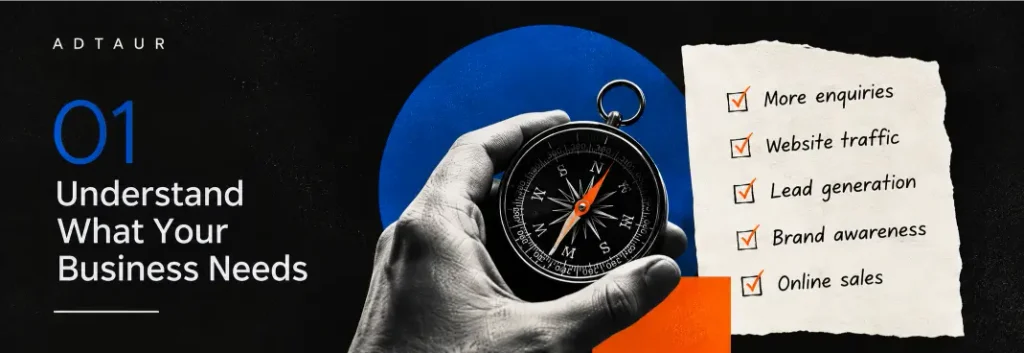
Define your primary marketing goal
Ask yourself what success should look like over the next three to six months. Your answer will help you evaluate agencies based on their ability to solve your actual problem.
For example:
-
- More local enquiries: Improve local SEO, Google Business Profile visibility, location-based search rankings and enquiry conversion.
-
- More website visitors: Invest in search engine optimisation, helpful content and relevant organic search opportunities.
-
- Faster lead generation: Consider Google Ads, Meta Ads and dedicated landing pages.
-
- Stronger brand awareness: Use social media marketing, video content, public relations and consistent brand communication.
-
- More online sales: Improve ecommerce SEO, product pages, paid campaigns and checkout conversion.
-
- Better-quality B2B leads: Combine targeted content, LinkedIn marketing, search advertising and a structured lead-nurturing process.
These objectives can overlap, but they should not be treated as interchangeable. More website traffic does not automatically mean more customers, and a large social media following does not guarantee revenue.
Consider your business size and sales cycle
A small business in Edappally may need a practical plan that generates calls, enquiries and walk-in customers without stretching its budget. A growing software company around Infopark may need a different approach, with technical content, lead qualification and a longer sales cycle.
A larger organisation may require coordinated campaigns, multiple landing pages, detailed reporting and integration with its existing customer relationship management system (CRM).
The best digital marketing company in Kochi for your business is therefore not necessarily the biggest or most expensive provider. It is the one that understands your goals, available resources, customers and route to revenue.

2. Look for an Agency That Understands Kochi’s Business Market
Local knowledge matters when your customers, competitors and sales opportunities are concentrated in a particular region. An agency serving businesses in Kochi should understand how local search, customer preferences and different commercial sectors influence marketing decisions.
Kochi is not a single, uniform market. Business needs can vary considerably between its commercial districts, technology hubs, residential neighbourhoods and tourism-oriented areas.
Understand the differences between local business areas
Kakkanad and Infopark
IT companies, software service providers, consultancies and B2B businesses may need qualified enquiries rather than large volumes of general traffic. Search-focused content, industry-specific landing pages, LinkedIn campaigns and well-defined lead funnels can support these objectives.
Edappally and surrounding retail areas
Retailers, restaurants, clinics and other customer-facing businesses can benefit from local search visibility, accurate business listings, customer reviews and mobile-friendly pages that make it easy to call, visit or enquire.
Fort Kochi and Mattancherry
Tourism, hospitality, cafes, cultural experiences and independent businesses can use location-relevant content, attractive visual storytelling, map visibility and booking-focused campaigns to reach residents and visitors.
MG Road, Vyttila and other commercial areas
Professional services, retailers, healthcare providers and established businesses may need a combination of search visibility, reputation management, paid advertising and conversion-focused website improvements.
These are examples of how marketing priorities can differ by location and business type, not claims that every business in a particular neighbourhood behaves the same way.
A capable agency should ask where your customers are, whether they travel to your business or expect a service at their location, and which areas are commercially important to you.
Ask how the agency approaches local competition
A useful local strategy goes beyond adding “Kochi” to a page title.
For example, a dental clinic may need to appear for treatment-related searches, make appointment information easy to find and build trust through accurate service information and genuine patient feedback. A B2B technology company may need detailed service pages that explain its capabilities to decision-makers comparing providers.
Ask prospective agencies how they would research your competitors, identify search opportunities and choose the most suitable channels for your audience.
The goal is to find a team that can explain why a strategy makes sense for your business, not simply offer a standard package to every client.
3. Evaluate the Digital Marketing Services You Actually Need
A full-service provider can be useful, but you do not need every available service from the beginning. Understand what each service does and how it contributes to your business objectives.
When comparing digital marketing services in Kochi, focus on the relationship between the service, the customer journey and the result you want to achieve.
Search engine optimisation (SEO)
SEO helps your website appear in relevant unpaid search results. It involves understanding search intent, improving website content, resolving technical issues and building your website’s authority through useful information and credible references.
A good SEO strategy may include:
-
- Keyword and competitor research.
-
- On-page optimisation and content improvements.
-
- Technical SEO and website performance checks.
-
- Internal linking and content planning.
-
- Relevant link earning and digital PR.
-
- Performance monitoring through Google Search Console and analytics.
If you are comparing SEO companies in Kochi, ask how they decide which keywords to target, how they measure progress and what work they will actually complete each month.
Be cautious of providers that guarantee a first-place Google ranking. Search positions depend on multiple factors, and no agency can honestly guarantee a particular organic ranking.
Local SEO in Kochi
Local SEO helps businesses become more visible when people search for services in a particular location. It can be especially useful for clinics, restaurants, professional services, retailers and businesses serving customers across Kochi and Ernakulam.
A local SEO programme may include:
-
- Improving your Google Business Profile, where eligible.
-
- Keeping your business name, address and contact details consistent.
-
- Selecting relevant business categories and maintaining accurate service information.
-
- Earning genuine customer reviews and responding professionally.
-
- Creating useful location-specific website content.
-
- Monitoring relevant local search queries and website enquiries.
An agency should not recommend creating dozens of nearly identical neighbourhood pages just to target more place names. Each page needs a genuine purpose and enough distinct information to help visitors.
It is also important to distinguish between a legitimate service-area business and a business with a customer-facing office. Your Google Business Profile should accurately represent your real-world operations.
Social media marketing
Social media helps businesses communicate with potential customers, demonstrate products or services and remain visible between purchase decisions.
A reliable strategy includes more than posting frequently. It should identify the audience, choose suitable platforms, establish a content direction and give interested users a clear next step.
For a restaurant, that might mean menus, short videos, customer experiences and reservation enquiries. For a professional services firm, useful educational content, project explanations and expert insights may be more appropriate.
When assessing a social media marketing agency in Kochi, ask how it plans content, evaluates engagement quality and connects social activity to enquiries, bookings or sales.
The aim is not to publish as much content as possible. It is to create content that attracts the right people and gives them a reason to take action.
Google Ads and Meta Ads
Paid advertising can help businesses reach potential customers while their organic visibility develops. However, campaign performance depends on targeting, competition, creative quality, landing pages, budget and follow-up.
Google Ads in Kochi may be useful when people are actively searching for a product or service. Search campaigns can target relevant commercial queries, while other campaign types may support different objectives.
Meta advertising on Facebook and Instagram can help businesses reach selected audiences, introduce an offer, generate enquiries or encourage conversations through suitable messaging channels.
A Meta Ads expert in Cochin should be able to explain the campaign objective, audience strategy, creative testing process, conversion tracking and lead-quality measurement.
Before hiring a provider, clarify who owns the advertising accounts, who controls the budget and how you will access campaign data.
Performance marketing
Performance marketing focuses on measurable actions such as qualified leads, purchases, bookings and other defined conversions.
A performance marketing agency in Kochi should connect campaign activity to business outcomes instead of reporting impressions and clicks alone.
That usually requires reliable conversion tracking, meaningful campaign objectives, suitable landing pages and a process for reviewing the quality of incoming leads.
For example, if a campaign generates 100 enquiries but only two become paying customers, the next step is not necessarily to increase the advertising budget. The business needs to understand lead quality, response times, pricing, audience fit and the sales process.
Website design and conversion optimisation
Your website is often where a potential customer decides whether to contact you.
A well-designed website should explain what you offer, demonstrate credibility and make the next step obvious. It should also work smoothly on mobile devices, where many local customers discover businesses.
Look for an agency that considers:
-
- Clear service descriptions and useful page structure.
-
- Mobile usability and reasonable loading performance.
-
- Simple enquiry forms and visible contact options.
-
- Relevant calls to action.
-
- Trust signals that can be substantiated.
-
- Analytics that help identify where visitors leave the journey.
Generating traffic is only part of the job. Helping the right visitors become enquiries is equally important.
4. Examine the Agency’s Website, Portfolio and Actual Work
An agency’s own website can offer useful clues about its attention to detail. It is not conclusive proof of its ability, but it gives you something concrete to evaluate before a sales conversation.
Start with its website. Is it easy to navigate? Are its services explained clearly? Does the content answer real questions? Can you find relevant information without working through vague claims?
Then examine the portfolio.
What to look for in case studies
A useful case study explains the starting problem, the work performed, the measurement period and the outcome. Strong examples also acknowledge the context behind the results.
For example, an SEO case study might explain that the team improved technical issues, reorganised service pages and published content targeting relevant searches. It could then show changes in organic clicks, qualified enquiries or other measurable outcomes over a defined period.
When reviewing evidence, ask:
-
- Was the work completed by the agency you are considering?
-
- What was the starting point?
-
- How long did the campaign run?
-
- Which metrics improved?
-
- Were the results measured in a reliable analytics platform?
-
- Did the improvement translate into a meaningful business outcome?
Do not assume that a high traffic figure automatically indicates a successful campaign. A website can attract many visitors who have little interest in buying its services.
Similarly, be careful with screenshots that lack dates, context or a clear explanation of the work behind them.
What if the agency has limited case studies?
A smaller studio may not have an extensive portfolio across every industry. That does not automatically make it unsuitable.
Instead, assess its research process, technical understanding, communication, proposed strategy and willingness to explain how it would approach your project.
An honest provider should distinguish between proven experience, relevant transferable skills and expected outcomes that still need to be tested.
5. Understand How the Agency Will Generate Leads
One of the most important questions to ask is simple: How will this work help my business get more customers?
The answer should connect visibility, customer intent, conversion and follow-up.
Build a complete lead-generation journey
Consider a local business that wants more enquiries from customers searching for its services.
1. Reach the right audience
Relevant Google searches, local listings, social content and paid campaigns.
2. Turn attention into interest
Useful service pages, clear pricing information where appropriate, proof and relevant offers.
3. Capture the enquiry
Forms, calls, bookings or consent-based WhatsApp conversations.
4. Follow up and measure
Respond promptly, qualify leads, record outcomes and improve the campaign.
Each stage matters. If people visit your website but cannot understand your offer, conversion rates may remain low. If the business receives enquiries but responds too late, the marketing investment may not translate into sales.
A capable agency should consider the entire journey rather than treating traffic generation as the final objective.
Use advanced methods where they solve a real problem
More advanced digital marketing does not always mean more complicated technology. It means choosing tools and processes that improve decisions.
Useful approaches include:
-
- Conversion tracking: Measure meaningful actions such as form submissions, calls and purchases, with suitable attribution and privacy controls.
-
- CRM integration: Record enquiries and track whether they progress to consultations, proposals or sales.
-
- Lead qualification: Separate enquiries that fit your services from those that do not.
-
- Remarketing: Re-engage eligible audiences using platforms and consent practices appropriate to the campaign.
-
- Marketing automation: Send relevant follow-up communications based on a person’s actions and permissions.
-
- Landing-page testing: Compare different headlines, forms and offers to see which better supports qualified conversions.
-
- Content clusters: Connect useful articles to relevant service pages so visitors can move naturally from learning to considering a provider.
For businesses serving Kochi, location-aware campaigns can also help distinguish audiences by service area. However, geographic targeting should reflect actual customer needs and platform capabilities rather than assumptions about a person’s income, identity or purchasing power.
6. Check How the Agency Measures and Reports Results
Reporting helps you understand whether your marketing investment is working and what should happen next.
Before signing a contract, ask for a sample report or an explanation of the metrics the agency plans to track.
A meaningful report should connect marketing activity to your business objective.
| Marketing goal | Useful metrics |
|---|---|
| Improve organic visibility | Organic clicks, relevant search impressions, query performance and qualified organic enquiries |
| Improve local visibility | Google Business Profile interactions, relevant local search visibility, calls and website visits |
| Generate paid leads | Cost per lead, conversion rate, qualified lead rate and cost per acquisition |
| Improve social media outcomes | Relevant reach, engagement, website actions and attributed enquiries |
| Increase online sales | Purchases, revenue, conversion rate and customer acquisition cost |
| Improve the sales funnel | Lead-to-meeting rate, meeting-to-sale rate and time to conversion |
The metrics should match the campaign. A brand-awareness campaign and a lead-generation campaign will not always have the same primary measures of success.
Ask who owns your accounts and data
Your business should retain appropriate access to its website, advertising accounts, analytics properties, creative assets and customer information.
Ask whether the agency will use your existing accounts or create new ones, how access will be managed and what happens if the engagement ends.
You should also understand which tracking tools are being installed, what data they collect and how the setup complies with relevant privacy requirements.
Transparent reporting is not simply a monthly PDF. It is a clear explanation of what happened, why it matters and what the team recommends doing next.
7. Compare Pricing, Deliverables and Contract Terms
Marketing costs vary according to the work involved, the level of competition, the number of channels and the amount of ongoing support required. A low quote is not automatically good value, and an expensive proposal is not automatically better.
The key is to understand what you are paying for.
Know what your package includes
Before accepting a proposal, check whether it clearly identifies:
-
- The services included in the monthly fee.
-
- The number and type of content assets or campaigns.
-
- Whether technical implementation is included.
-
- Whether advertising spend is separate from management fees.
-
- Who is responsible for creative production and landing pages.
-
- What reports and meetings you will receive.
-
- Any additional charges for tools, development or revisions.
This matters particularly when comparing providers offering SEO, social media management or paid advertising. Two packages with similar names may involve very different amounts of work.
Separate advertising spend from management fees
Suppose your business allocates ₹30,000 per month to a paid campaign. If the agency’s management fee is separate, you need to understand how much goes towards advertising and how much covers strategy, setup, optimisation and reporting.
The appropriate budget depends on your objectives, competition, expected customer value and ability to handle enquiries. There is no universal amount that guarantees profitable results.
For a small business, it may be sensible to begin with a focused campaign and a clearly defined measurement plan. As reliable results emerge, the budget can be reviewed.
Read the contract before committing
Check the notice period, payment schedule, cancellation terms, deliverables and ownership arrangements. Avoid long commitments that leave you unclear about what happens if the service does not meet agreed expectations.
Organic SEO usually takes time to develop, while paid campaigns can produce data more quickly. Neither channel should be judged without considering the starting position, implementation quality and time needed to evaluate performance.
A trustworthy provider will set realistic expectations and explain what can and cannot be known at the beginning.
8. Identify Red Flags Before You Hire
A polished proposal can make almost any agency sound convincing. Your job is to separate a credible plan from an attractive sales pitch.
Watch for these warning signs.
Guaranteed rankings or instant results
No provider can guarantee a first-place Google ranking for a competitive keyword. Similarly, promising a fixed number of profitable leads without understanding your market, offer and budget is a reason to ask more questions.
An agency should explain the factors it can influence and how it will measure progress.
Vague strategies
If a proposal says it will improve SEO, grow social media and run advertisements but never explains what work will be performed, you do not have enough information to make a sound decision.
Ask for a clear scope, initial priorities and a measurement plan.
Vanity metrics presented as business success
Followers, impressions and website visits can be useful indicators, but they are not substitutes for business outcomes.
If your objective is to generate qualified enquiries, the agency should be willing to discuss enquiry quality, cost per lead and eventual sales where the data is available.
No access to your own accounts
Be cautious if a provider refuses to give you appropriate access to advertising platforms, analytics or campaign data.
Your business should not become dependent on an agency simply because it controls the information needed to understand your marketing performance.
Copied content and questionable link-building
Publishing repetitive articles or acquiring irrelevant backlinks simply to increase a metric can create long-term problems. Ask how the agency develops original content, evaluates link opportunities and follows search engine guidelines.
Poor communication
An agency may have strong technical skills but still be a difficult partner if it regularly misses meetings, provides unclear updates or avoids explaining its decisions.
Good communication matters because digital marketing often requires cooperation between the agency, business owner, sales team and website team.
9. Match the Agency to Your Industry and Business Model
Different industries have different customer journeys. Choosing a provider with a relevant understanding of your business can help shorten the learning process and improve the quality of the strategy.
Kochi’s diverse economy makes this especially important.
| Business type | Marketing priorities to discuss |
|---|---|
| Restaurants and cafes | Local SEO, menus, reviews, social content, reservations and local campaigns |
| Clinics and healthcare providers | Accurate service pages, local visibility, appointment enquiries, reputation management and responsible healthcare advertising |
| IT and B2B services | Technical content, service-specific SEO, LinkedIn, search campaigns and qualified lead nurturing |
| Retail and ecommerce | Product visibility, paid campaigns, social commerce, product-page optimisation and purchase tracking |
| Hotels and tourism businesses | Destination content, search visibility, reviews, booking journeys and seasonal campaigns |
| Education and training | Course pages, search campaigns, enquiry qualification and follow-up sequences |
| Professional services | Expertise-led content, local SEO, clear service pages and consultation enquiries |
| Manufacturing and industrial firms | Technical product information, sector-specific content, B2B search visibility and sales-qualified enquiries |
These are starting points, not fixed formulas. Your actual strategy should reflect your customers, margins, sales process and competitive position.
Consider your sales cycle
A restaurant may receive a reservation enquiry and convert it into a sale within hours. A business selling software or industrial equipment may need several conversations before a prospect becomes a customer.
For the first business, campaign performance may be evaluated through bookings and revenue. For the second, qualified leads, meeting rates and sales opportunities may be more useful early indicators.
The agency should understand these differences before recommending a channel or promising a result.
10. Ask These Questions Before Making Your Final Decision
Once you have shortlisted a few providers, use the same questions to compare their approaches.
1. How would you approach my business during the first 90 days?
Look for a phased plan covering research, implementation, measurement and optimisation rather than an immediate promise of results.
2. Which channels would you prioritise, and why?
The answer should connect your business goals to customer behaviour, search demand, budget and sales cycle.
3. How will you measure qualified leads?
Ask how the team will distinguish a genuine sales opportunity from a low-quality form submission or casual enquiry.
4. Who will work on my account?
Understand who handles strategy, content, advertising, technical implementation and reporting.
5. Can you show relevant work and explain the results?
Look for verifiable evidence and a clear explanation of what the agency contributed.
6. What do you need from my business?
A realistic plan may require access to your website and analytics, product information, customer insights, sales feedback or approval of creative assets.
7. What happens if the strategy is not working?
A good answer explains how the agency diagnoses problems, tests alternatives and adjusts priorities.
Compare the quality of the answers, not simply the confidence with which they are delivered. The strongest proposal should make the strategy understandable and show how progress will be evaluated.
11. Why a Strategy-First Digital Marketing Studio Can Be the Right Choice
The structure of a provider matters less than the quality of its work, but it is worth understanding the difference between common service models.
A large agency may offer a broad team and resources for complex campaigns. A smaller studio may provide more direct communication, closer involvement from its core team and a more focused approach to the work.
Neither model is automatically superior.
For a small or growing business, a strategy-first digital marketing studio can be a sensible option when it offers clear deliverables, realistic priorities and direct access to the people responsible for the work.
The important questions are whether the provider understands your business, has the skills your project requires and can support your growth without selling services you do not need.
Where ADTAUR fits
ADTAUR is a founder-led digital marketing studio serving businesses in Kerala. Its service areas include SEO, local SEO, social media marketing, paid advertising, performance marketing, website design, content marketing and email marketing.
The approach behind a suitable engagement should begin with understanding your business goals and current digital presence, then identifying the work most likely to support those goals.
For a Kochi business, that could mean improving service-page visibility, strengthening local search signals, developing a more effective landing page or connecting advertising campaigns to meaningful conversion data.
It does not mean every business needs every service at once.
The priority should be a clear strategy, well-defined work and an honest way to evaluate results.
12. A Practical 90-Day Plan for Your First Marketing Engagement
You do not need to overhaul every part of your digital presence on day one. A structured first 90 days gives you time to understand the current situation, implement improvements and assess early evidence.
The exact timeline will depend on your website, budget, industry and the services you choose.
01
Days 1–30: Research and establish the baseline
Review your website, existing rankings, local listings, competitors, customer journey and analytics setup. Agree on the main objective, target audience, priorities and measurement criteria.
Expected output: a documented strategy, baseline metrics and an implementation plan.
02
Days 31–60: Implement the priority improvements
Optimise important pages, address technical issues, improve conversion paths and launch suitable content or paid campaigns. Configure tracking so important enquiries can be measured.
Expected output: completed priority tasks, functioning conversion paths and initial campaign data where applicable.
03
Days 61–90: Evaluate and refine
Review search performance, advertising costs, enquiry quality and conversion rates. Identify weak points and decide where the next investment should go.
Expected output: a performance review, lessons from the data and a prioritised next-quarter plan.
This is a working framework, not a guarantee of rankings or revenue within 90 days. Some improvements can be measured quickly, while SEO growth and longer B2B sales cycles may require a longer evaluation period.
The value of the first three months lies in establishing a sound foundation and making decisions based on evidence rather than assumptions.
13. How to Choose the Best Digital Marketing Agency in Kochi: Your Final Checklist
Before signing a contract, review your shortlisted providers against the criteria below.
Agency evaluation checklist
0/10 reviewedUnderstands my business goals and target customersCan explain a strategy specific to my businessOffers the services my priorities actually requireProvides relevant examples or credible evidence of its workMeasures leads and business outcomes, not just activityExplains pricing, deliverables and additional costs clearlyGives me appropriate access to my accounts and dataSets realistic expectations without ranking or revenue guaranteesCommunicates clearly and explains how progress will be reviewedHas a defined process for improving underperforming campaigns
Use this checklist to compare providers consistently. A checked list is a starting point, not a substitute for reviewing the actual proposal and contract.
The best choice is the provider that combines relevant expertise, a clear strategy, transparent communication and a realistic understanding of your business.
You do not need an agency that promises to do everything. You need a partner that can explain what should be done first, why it matters and how you will know whether it is working.

Make Your Next Marketing Decision With Clarity
Finding the right digital marketing partner starts with understanding what your business needs and evaluating how a provider plans to deliver it.
For businesses in Kochi and Ernakulam, a strong strategy may combine local search visibility, useful content, paid campaigns, an effective website and a reliable process for handling enquiries. The mix should reflect your customers and commercial objectives, not a generic package.
Take the time to compare proposals, ask specific questions and look for evidence behind the promises.
If you are exploring ways to improve your online visibility or generate more qualified enquiries, ADTAUR can help you assess the opportunities and identify suitable next steps.