

Introduction
The internet has created endless opportunities for businesses. Today, a local shop can reach customers across a city, a country, or even the world. Social media platforms, search engines, websites, AI tools, and digital advertising have made it easier than ever to attract potential customers.
Yet, despite these opportunities, many businesses struggle to grow online. Some invest heavily in websites, social media, and advertisements but still fail to generate leads or sales. Others spend months creating content only to see little or no results.
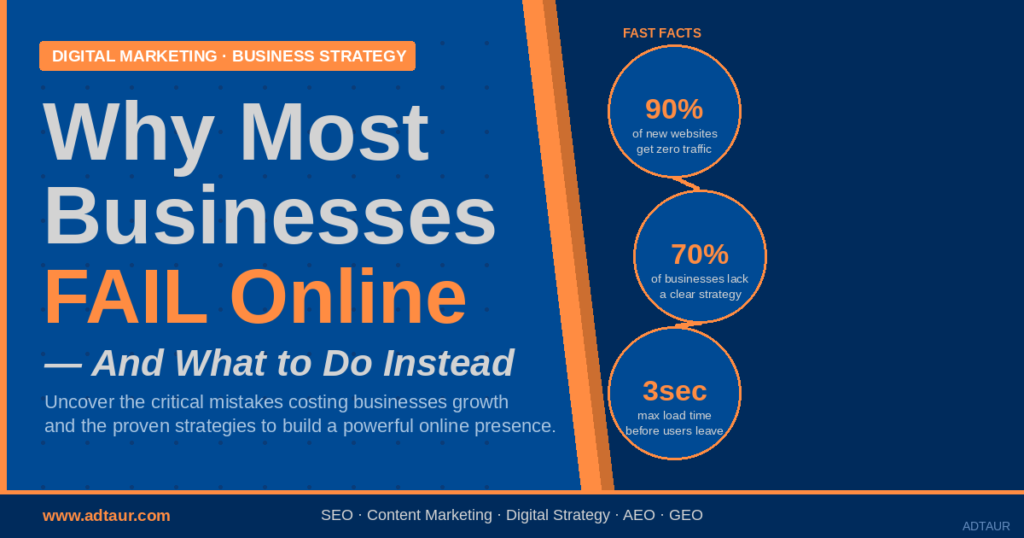
The problem is not that online business is difficult. The problem is that many businesses focus on the wrong strategies, ignore customer behavior, and fail to build a strong digital foundation. Understanding these mistakes is the first step toward building a successful online presence.
This article explores the major reasons why most businesses fail online and what they can do to achieve sustainable growth.
The Online Market Is More Competitive Than Ever
Many business owners assume that simply creating a website or social media page is enough to attract customers. Unfortunately, millions of businesses are competing for the same audience.
Every day, thousands of new websites, blog posts, videos, and advertisements are published. Customers have more choices than ever before.
The Reality of Online Competition
| Traditional Market | Online Market |
|---|---|
| Limited local competitors | Global competition |
| Restricted audience reach | Unlimited audience reach |
| Fewer marketing channels | Hundreds of marketing channels |
| Lower content volume | Massive content saturation |
Businesses that fail to stand out often become invisible among competitors.
To succeed online, businesses must create unique value and communicate it clearly to their target audience.
Lack of a Clear Digital Strategy
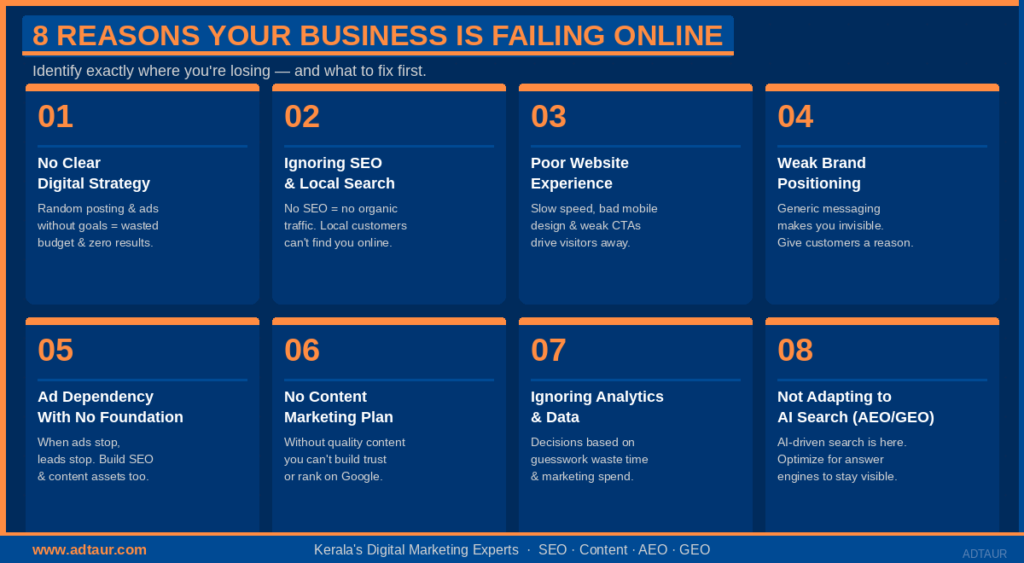
One of the biggest reasons businesses fail online is the absence of a well-defined strategy.
Many companies start posting on social media, running advertisements, or publishing blogs without clear goals.
Common Strategic Mistakes
- Posting content randomly
- Running ads without audience research
- Building websites without SEO
- Ignoring customer journeys
- Chasing trends without purpose
- Focusing on vanity metrics
Without a strategy, marketing becomes a series of disconnected activities rather than a system designed to generate results.
What Successful Businesses Do
Successful businesses define:
- Their target audience
- Their goals
- Their content strategy
- Their SEO strategy
- Their lead generation process
- Their conversion process
Every marketing effort works together toward a specific objective.
Poor Understanding of Customer Needs
Many businesses focus too much on themselves and not enough on their customers.
Customers are not interested in how great a company thinks it is. They want solutions to their problems.
Example
A digital marketing agency might say:
” We provide innovative and advanced marketing solutions.”
A customer is more likely to respond to:
” We help businesses generate more leads, improve search visibility, and increase revenue.”
The second statement focuses on outcomes rather than features.
Businesses that fail online often create content centered on their products rather than customer challenges.
Weak Brand Positioning
Thousands of businesses offer similar products and services.
When customers cannot identify what makes a business different, they often choose the cheapest option or the most recognizable brand.
Signs of Weak Positioning
- Generic messaging
- No clear unique selling proposition
- Similar content to competitors
- Inconsistent branding
- Lack of authority
Strong positioning answers a simple question:
Why should customers choose you instead of competitors?
Businesses that cannot answer this question struggle to build trust and attract loyal customers.
Ignoring Search Engine Optimization (SEO)
Many businesses invest heavily in social media while completely ignoring SEO.
This is a major mistake.
Social media content has a short lifespan. A post may disappear within hours or days.
SEO creates long-term visibility.
When customers search for products, services, or solutions on search engines, businesses with strong SEO appear in search results and receive organic traffic.
Benefits of SEO
| Benefit | Impact |
|---|---|
| Increased visibility | More potential customers |
| Organic traffic | Reduced advertising costs |
| Higher credibility | Better trust |
| Long-term growth | Sustainable lead generation |
| Better user experience | Higher conversions |
Businesses that ignore SEO often become dependent on paid advertising, which increases costs over time.
Believing SEO Is Dead
Many people claim SEO is no longer effective.
This belief causes businesses to neglect one of the most important digital assets they can build.
The reality is that SEO has evolved.
Modern SEO includes:
- Technical SEO
- Content SEO
- User experience optimization
- Entity optimization
- Topic authority
- Structured data
- Local SEO
SEO is no longer about stuffing keywords into content. It is about helping search engines and AI systems understand expertise, authority, and relevance.
Businesses that adapt to modern SEO continue to benefit from long-term organic visibility.
Failing to Adapt to AI Search
Search behavior is changing rapidly.
People are increasingly using AI-powered search experiences and chatbots to find information.
Platforms now generate direct answers rather than simply displaying a list of websites.
This shift has introduced two important concepts:
Answer Engine Optimization (AEO)
AEO focuses on creating content that directly answers user questions.
Examples include:
- FAQs
- Step-by-step guides
- Definitions
- Structured answers
Generative Engine Optimization (GEO)
GEO focuses on helping AI systems understand and reference your content when generating responses.
Businesses that ignore these changes risk losing visibility as AI-driven search becomes more common.
No Content Marketing Strategy
Content remains one of the most effective methods for building trust online.
However, many businesses either:
- Publish poor-quality content
- Publish inconsistent content
- Stop creating content too early
Content marketing is a long-term investment.
Effective Content Types
- Blog posts
- Case studies
- Service pages
- Industry guides
- Videos
- Tutorials
- FAQs
- Whitepapers
High-quality content helps businesses:
- Build authority
- Rank in search engines
- Generate leads
- Educate customers
- Improve trust
Businesses that fail to invest in content often struggle to gain visibility.
Overdependence on Paid Advertising
Advertising can generate quick traffic, but it should not be the only source of business growth.
Many companies become trapped in a cycle where they must continuously spend money to generate leads.
Problems With Ad Dependence
- Rising advertising costs
- Lower profit margins
- Increased competition
- Reduced sustainability
When advertisements stop, traffic often stops as well.
Successful businesses combine:
- SEO
- Content marketing
- Social media
- Email marketing
- Paid advertising
This creates a balanced growth system.
Poor Website Experience
A website is often the first impression customers have of a business.
Unfortunately, many websites suffer from:
- Slow loading speeds
- Confusing navigation
- Poor design
- Mobile issues
- Weak calls-to-action
Website Problems That Hurt Conversions
| Problem | Result |
|---|---|
| Slow loading speed | Higher bounce rates |
| Poor mobile experience | Lost users |
| Confusing layout | Lower engagement |
| Weak trust signals | Reduced conversions |
| Complicated forms | Fewer leads |
A website should guide visitors toward taking action.
Without a strong user experience, traffic alone will not generate results.
Lack of Trust and Authority
Trust is one of the most important factors in online success.
Customers cannot physically visit your business when browsing online.
Therefore, they rely on signals that indicate credibility.
Trust Signals
- Customer reviews
- Testimonials
- Certifications
- Case studies
- Awards
- Industry recognition
- Secure website connections
Businesses without trust signals often struggle to convert visitors into customers.
Inconsistent Branding
Consistency builds recognition.
Many businesses use different messages, colors, visuals, and tones across platforms.
This creates confusion.
Strong brands maintain consistency across:
- Websites
- Social media
- Advertising
- Email campaigns
- Blog content
Consistency strengthens brand recall and customer confidence.
Not Understanding Analytics
Many businesses make decisions based on assumptions rather than data.
Digital marketing provides access to valuable information about customer behavior.
Important metrics include:
- Traffic sources
- Conversion rates
- Bounce rates
- Engagement metrics
- Keyword rankings
- Lead quality
Businesses that ignore analytics often continue investing in ineffective strategies.
Data-driven decisions improve efficiency and growth.
Lack of Patience
One of the biggest reasons businesses fail online is unrealistic expectations.
Many expect immediate results from:
- SEO
- Content marketing
- Brand building
- Organic growth
In reality, digital success requires consistency.
Typical Growth Timelines
| Strategy | Expected Timeline |
|---|---|
| Paid Ads | Immediate |
| Social Media Growth | Months |
| SEO | Several months |
| Content Marketing | Long-term |
| Brand Authority | Long-term |
Businesses that quit too early often abandon strategies just before results begin to appear.
Focusing on Traffic Instead of Conversions
Traffic alone does not generate revenue.
A website with 100 targeted visitors can outperform a website with 10,000 untargeted visitors.
The goal is not simply attracting visitors.
The goal is attracting the right visitors and converting them into customers.
Conversion Optimization Areas
- Landing pages
- Calls-to-action
- Forms
- Trust signals
- Page speed
- Mobile usability
Businesses that focus only on traffic often miss opportunities to increase revenue.
Failure to Build Long-Term Assets
Many businesses focus entirely on short-term tactics.
Examples include:
- Viral posts
- Temporary trends
- Quick advertising campaigns
Successful businesses build long-term digital assets such as:
- Optimized websites
- Blog libraries
- Email lists
- Customer communities
- Brand authority
- Search visibility
These assets continue generating value for years.
Lack of Local SEO
Many local businesses overlook local search optimization.
When customers search for nearby products or services, search engines prioritize local results.
Important Local SEO Elements
- Google Business Profile
- Local citations
- Customer reviews
- Location pages
- Local keywords
Businesses that ignore local SEO often lose customers to competitors appearing in local search results.
Treating Digital Marketing as an Expense
Many businesses view marketing as a cost rather than an investment.
As a result, they:
- Cut budgets too early
- Stop campaigns prematurely
- Avoid long-term strategies
Successful businesses understand that marketing drives growth.
Strategic investments in SEO, content, branding, and customer experience often generate returns far greater than the initial cost.
Why SEO, AEO, and GEO Are Becoming Essential
The future of online visibility depends on more than traditional marketing.
Businesses now need to optimize for:
SEO
Helps businesses appear in search results.
AEO
Helps businesses appear in direct answers.
GEO
Helps businesses become visible in AI-generated responses.
Together, these strategies create a powerful digital presence.
SEO provides the foundation.
AEO improves answer visibility.
GEO increases AI discoverability.
Businesses that adopt all three are better positioned for the future of search.
Conclusion
Most businesses fail online not because the internet lacks opportunities, but because they approach digital growth without a clear strategy. Common mistakes include ignoring SEO, producing weak content, relying too heavily on paid advertising, neglecting user experience, failing to build trust, and overlooking emerging technologies such as AI-powered search.
The businesses that succeed online focus on long-term value rather than short-term gains. They invest in SEO, content marketing, brand authority, customer experience, AEO, and GEO while continuously adapting to changing search behavior.
Online success is not about finding a secret shortcut. It is about building a strong digital foundation, understanding customer needs, and consistently delivering value. Businesses that embrace these principles are far more likely to grow, compete, and thrive in the modern digital landscape.