

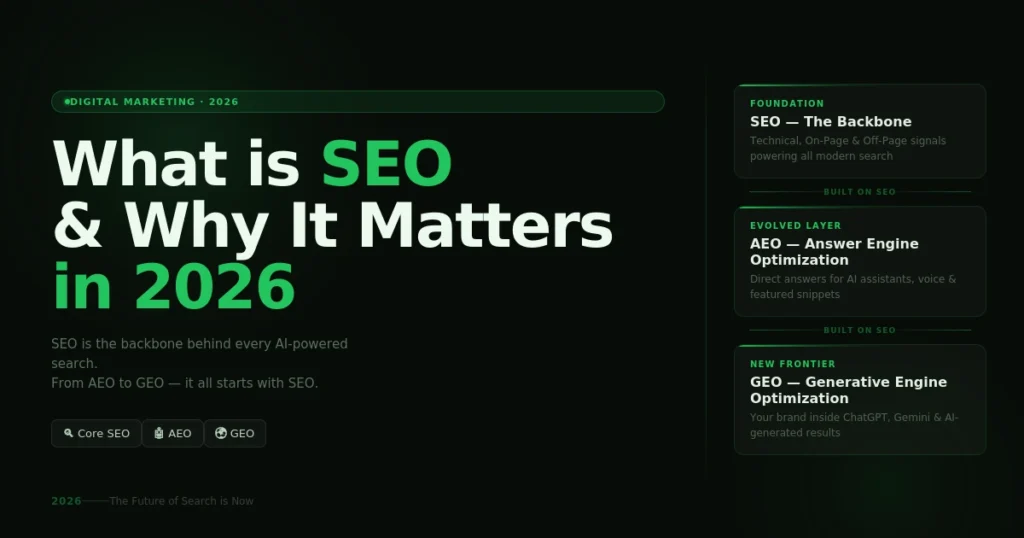
The digital world is changing rapidly. Businesses are no longer competing only with nearby competitors. Today, every company is competing for visibility online. Whether someone wants to buy a product, hire a service, visit a restaurant, or learn something new, the first thing they usually do is search online.
This is exactly where SEO becomes important.
SEO is one of the most powerful digital marketing strategies for long-term business growth. It helps businesses improve visibility, attract targeted customers, build authority, and generate sustainable traffic organically.
However, many people believe SEO is dying because of artificial intelligence, AI chatbots, and changing search behavior. The reality is completely different.
SEO is not dead.
SEO has evolved.
Modern SEO now powers visibility not only on search engines but also inside AI-generated search experiences, voice assistants, answer engines, and conversational AI platforms.
Businesses that understand this evolution early are building stronger digital authority and staying ahead of competitors.
What Is SEO?
SEO, or Search Engine Optimization, is the process of improving a website’s visibility in search engines like Google and Bing.
The primary goal of SEO is simple:
- help businesses appear in front of users searching online
- increase organic traffic
- improve visibility
- generate inquiries and conversions
Whenever users search for:
- products
- services
- information
- solutions
search engines analyze thousands of websites and decide which pages deserve visibility.
SEO helps businesses improve the factors search engines use for ranking.
How Search Engines Work
Search engines use three major processes to organize and rank websites.
| Process | Purpose |
|---|---|
| Crawling | Discovering pages using bots |
| Indexing | Storing and organizing content |
| Ranking | Showing the best results for searches |
Search engines constantly scan websites to understand:
- page content
- keywords
- structure
- user experience
- authority
- relevance
SEO improves these signals so search engines can better understand and trust a website.
Why SEO Matters More Than Ever
Consumer behavior has completely changed over the last decade.
Before making decisions, people now search online for:
- products
- services
- reviews
- comparisons
- nearby businesses
If a business is not visible online, customers often choose competitors instead.
SEO helps businesses appear exactly when users are actively searching.
This makes SEO traffic extremely valuable because users already have intent.
For example, someone searching:
is already looking for a service.
That search intent creates high-quality traffic with strong conversion potential.
Types of SEO
Modern SEO includes multiple areas working together.
On-Page SEO
On-page SEO focuses on optimizing content and page structure.
This includes:
- keywords
- headings
- internal links
- meta titles
- image optimization
- semantic relevance
- content formatting
Good on-page SEO improves readability for both users and search engines.
Technical SEO
Technical SEO focuses on website performance and backend optimization.
Important technical SEO factors include:
- website speed
- mobile responsiveness
- indexing
- XML sitemaps
- structured data
- Core Web Vitals
- crawlability
Technical SEO ensures search engines can properly access and understand a website.
Off-Page SEO
Off-page SEO focuses on building website authority externally.
This includes:
- backlinks
- brand mentions
- digital PR
- citations
- authority signals
Strong authority improves trust and rankings.
Local SEO
Local SEO helps businesses appear in geographically targeted searches.
Local SEO is extremely important for:
- agencies
- restaurants
- clinics
- local service providers
- stores
Core Benefits of SEO for Businesses
SEO provides long-term advantages that many other marketing channels cannot match.
| Benefit | Business Impact |
|---|---|
| Increased Visibility | More people discover the business |
| Organic Traffic | Consistent targeted visitors |
| Brand Authority | Builds trust and credibility |
| Long-Term Growth | Sustainable traffic over time |
| Better User Experience | Improves usability and engagement |
| Higher Conversion Potential | Attracts users with intent |
Unlike paid advertising, SEO continues delivering results over time even after content is published.
SEO vs Paid Advertising
Many businesses compare SEO with paid advertising.
Both are valuable, but they work differently.
| SEO | Paid Ads |
|---|---|
| Long-term growth | Immediate traffic |
| Organic visibility | Paid visibility |
| Sustainable results | Stops when budget ends |
| Builds authority | Builds short-term exposure |
| Higher long-term ROI | Faster short-term reach |
The best digital marketing strategies combine:
- SEO
- paid advertising
- content marketing
- social media marketing
instead of depending on only one channel.
Is SEO Dead?
One of the most common myths today is:
SEO IS DEAD!!
People often say this because:
- AI tools are growing
- Google is changing
- AI Overviews are appearing
- voice search is increasing
But SEO has survived every major digital transformation.
The truth is simple:
SEO is not dead.
SEO has upgraded.
Why People Think SEO Is Dying
AI-generated answers are changing how users consume information.
Platforms like:
- ChatGPT
- Google AI Overviews
- Perplexity
- Bing Copilot
can now generate direct answers without users visiting multiple websites.
This increases:
- zero-click searches
- AI summaries
- conversational search behavior
However, AI systems still depend on reliable information sources.
And those sources are optimized websites.
SEO remains the foundation of discoverability.
The Rise of AEO and GEO
Modern search is evolving into something much larger than traditional search engines.
This evolution introduced:
- AEO
- GEO
These are not replacements for SEO.
They are extensions of SEO.
What Is AEO?
AEO stands for Answer Engine Optimization.
AEO focuses on helping content appear in:
- featured snippets
- voice search
- AI summaries
- direct answer boxes
AEO prioritizes:
- concise answers
- question-based formatting
- structured content
- clear hierarchy
The goal is helping search engines extract direct answers quickly.
What Is GEO?
GEO stands for Generative Engine Optimization.
GEO focuses on visibility inside AI-generated systems like:
- ChatGPT
- Google AI Overviews
- Bing AI
- Perplexity AI
Instead of optimizing only for rankings, GEO helps content become:
- AI-readable
- contextually clear
- semantically structured
- citation-friendly
SEO Is the Backbone of AEO and GEO
This is the most important concept businesses must understand.
AEO and GEO do not work without SEO.
SEO powers:
- indexing
- crawlability
- content structure
- semantic understanding
- authority
- trust signals
Without strong SEO:
- AI systems struggle to trust content
- search engines cannot understand websites properly
- discoverability decreases
Think of SEO as the foundation of a building.
AEO and GEO are modern layers built on top of that foundation.
Without SEO, neither system functions effectively.
Traditional SEO vs Modern SEO
| Traditional SEO | Modern SEO |
|---|---|
| Keyword-focused | Intent-focused |
| Search engine only | Search + AI visibility |
| Ranking pages | Answering questions |
| Blue-link optimization | Conversational optimization |
| Search traffic focus | Multi-platform discoverability |
Modern SEO now supports visibility across:
- Google Search
- AI Overviews
- ChatGPT
- voice assistants
- image search
- YouTube search
- conversational AI
SEO is expanding, not disappearing.
Why Businesses Need SEO in the AI Era
Some businesses mistakenly believe AI will replace websites entirely.
In reality, AI systems still require:
- trusted sources
- authoritative websites
- structured information
- high-quality content
Businesses with strong SEO foundations are more likely to become:
- AI citations
- trusted references
- recommended brands
Ignoring SEO today can reduce visibility in both search engines and AI systems.
The Importance of Content in Modern SEO
Content remains one of the strongest SEO ranking factors.
However, modern content is very different from old keyword-stuffing strategies.
High-quality content today should be:
- informative
- structured
- user-focused
- semantically relevant
- AI-readable
Good content answers:
- user intent
- customer questions
- practical problems
Businesses consistently publishing valuable content build stronger authority over time.
Website Performance and User Experience
SEO is no longer only about keywords.
Website performance also affects:
- rankings
- engagement
- conversions
Important performance factors include:
| SEO Performance Factor | Why It Matters |
|---|---|
| Mobile Responsiveness | Most users browse on mobile |
| Website Speed | Faster websites improve engagement |
| Core Web Vitals | Important ranking signals |
| Navigation | Better user experience |
| Readability | Improves retention and usability |
Search engines increasingly prioritize websites that provide strong user experiences.
SEO Builds Long-Term Digital Assets
Paid ads stop generating traffic when spending stops.
SEO continues building visibility over time.
A well-optimized article can generate:
- traffic
- leads
- authority
- brand recognition
for years.
This makes SEO one of the highest-return long-term digital marketing investments.
The Future of SEO
The future of SEO is not about manipulating algorithms.
It is about:
- creating valuable experiences
- helping users
- building trust
- improving discoverability
- optimizing for AI systems
Businesses focusing on:
- high-quality content
- technical optimization
- semantic relevance
- AI discoverability
- user experience
will continue succeeding regardless of algorithm changes.
Final Thoughts
SEO is not dying.
It is evolving into a much broader digital visibility strategy.
Modern SEO now powers:
- search engines
- AI-generated search
- answer engines
- conversational search
- voice assistants
- generative AI systems
AEO and GEO are not replacing SEO.
They are built on top of SEO.
Businesses investing in SEO today are not only improving Google rankings. They are building the digital foundation required for visibility across the future AI-powered internet.
The businesses that adapt early will gain stronger authority, better discoverability, and sustainable long-term growth in both traditional search engines and emerging AI ecosystems.