

Digital marketing is evolving faster than ever before. Traditional marketing strategies that once worked effectively are no longer enough to maintain strong online visibility or generate consistent business growth. Search engines are becoming smarter, artificial intelligence is changing how people search for information, and users now expect faster, more personalized online experiences.
In 2026, businesses are no longer competing only for search engine rankings. They are competing for visibility inside AI-generated answers, voice assistants, recommendation systems, and conversational search platforms. This major shift is transforming the entire digital marketing industry.
Modern businesses must now optimize not only for users and search engines but also for AI systems that summarize, recommend, and generate answers from online content. Strategies such as SEO, GEO, and AEO are becoming essential for long-term online success.
Companies that adapt early to these changes will build stronger authority, attract better-quality traffic, and gain a major competitive advantage in the future digital landscape.
What Is Digital Marketing in 2026?
Digital marketing refers to promoting products, services, or brands using digital platforms such as websites, search engines, social media, email, and online advertising.
However, digital marketing in 2026 is far more advanced than traditional online promotion. It now combines several interconnected strategies that work together to improve visibility, authority, engagement, and conversions.
Modern digital marketing includes:
- Search Engine Optimization (SEO)
- Generative Engine Optimization (GEO)
- Answer Engine Optimization (AEO)
- Social Media Marketing (SMM)
- Search Engine Marketing (SEM)
- Content marketing
- AI-driven optimization
- Website performance optimization
- Conversion rate optimization
Businesses no longer focus only on generating traffic. The primary goal today is to create meaningful digital experiences that build trust, improve engagement, and convert visitors into customers.
Why Traditional SEO Alone Is No Longer Enough
For many years, ranking on the first page of Google was the main objective of SEO. Businesses focused heavily on keywords, backlinks, and technical optimization to increase search visibility.
While SEO still remains extremely important, the search ecosystem has changed significantly.
Today, users often receive direct answers from:
- AI-generated summaries
- Voice assistants
- Google AI Overviews
- Conversational search systems
- AI recommendation platforms
Instead of visiting multiple websites, users increasingly consume information directly from AI-generated responses.
This means businesses must now optimize content in a way that AI systems can easily understand, trust, and reference.
Websites that fail to adapt may slowly lose visibility even if they still rank well in traditional search results.
Understanding SEO, GEO, and AEO
Modern digital marketing relies heavily on these three optimization strategies.
Search Engine Optimization (SEO)
SEO helps websites rank higher in search engines like Google.
The primary goal of SEO is to improve organic visibility and attract relevant users through search results.
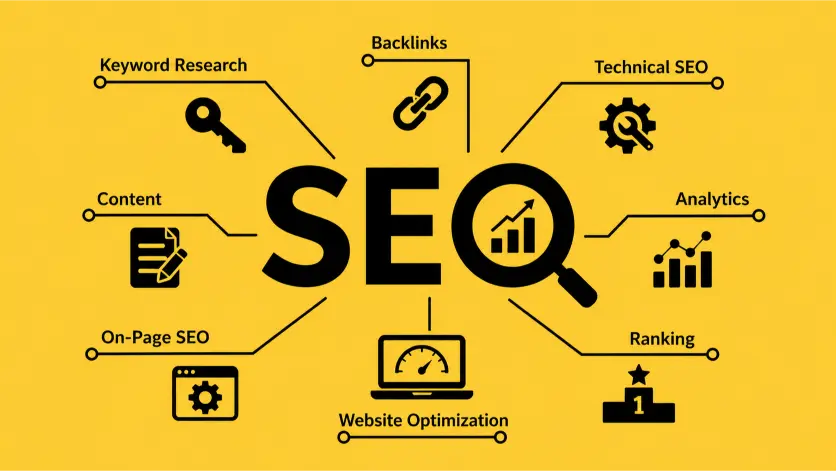
SEO includes:
- Keyword optimization
- Technical SEO
- Internal linking
- Backlink building
- Mobile optimization
- Website speed optimization
- Structured content creation
For example, if someone searches for:
best digital marketing agency in KeralaSEO helps relevant websites appear higher in the search results.
Good SEO improves:
- organic traffic
- user experience
- credibility
- lead generation
- long-term brand authority
Generative Engine Optimization (GEO)
GEO stands for Generative Engine Optimization.
This is one of the newest and most important digital marketing strategies in 2026.
GEO focuses on optimizing content for AI-generated answers and conversational search systems.
Instead of optimizing only for search engine rankings, GEO helps websites become visible inside:
- ChatGPT responses
- AI search summaries
- voice assistants
- Bing AI
- AI-powered recommendation systems
GEO optimization involves:
- clear content structure
- semantic relevance
- entity optimization
- concise explanations
- authoritative information
- conversational formatting
Content optimized for GEO is easier for AI systems to understand and reference.
Answer Engine Optimization (AEO)
AEO stands for Answer Engine Optimization.
This strategy focuses on helping search engines deliver direct answers from your content.
AEO improves visibility in:
- featured snippets
- FAQ results
- voice search
- AI summaries
- zero-click search results
AEO content is usually:
- highly structured
- easy to scan
- question-focused
- concise and informative
Businesses that implement AEO effectively gain higher visibility across modern search experiences.
The Importance of Website Speed and User Experience
Website speed has become one of the most important ranking and conversion factors.
Users expect websites to load almost instantly. Slow-loading websites create frustration, increase bounce rates, and reduce trust.
A fast website improves:
- SEO performance
- mobile usability
- engagement
- conversion rates
- customer retention
Google measures website performance using Core Web Vitals.
Important metrics include:
- Largest Contentful Paint (LCP)
- First Contentful Paint (FCP)
- Interaction to Next Paint (INP)
- Cumulative Layout Shift (CLS)
Businesses that optimize website performance usually experience higher rankings and better user engagement.
Ideal Website Performance Metrics
Recommended website speed benchmarks
Ideal performance targets for SEO and user experience optimization.0s0.65s1.3s1.95s2.6sLCPFCPINPTTFB
Improving these metrics helps websites perform better in both search rankings and real-world usability.
The Role of Content Marketing in Modern SEO
Content remains one of the strongest pillars of digital marketing.
However, modern content marketing is no longer about publishing large volumes of keyword-focused articles. Search engines and AI systems now prioritize high-quality, experience-driven content.
Strong content should:
- solve user problems
- answer search intent clearly
- provide real value
- maintain readability
- demonstrate expertise
High-performing content usually includes:
- proper heading structure
- semantic keywords
- FAQs
- internal linking
- optimized images
- examples and case studies
- conversational formatting
Businesses that consistently publish valuable content build stronger topical authority over time.
Social Media Marketing in 2026
Social media platforms are becoming powerful discovery engines.
Users now search directly on platforms like:
- YouTube
- TikTok
instead of relying only on search engines.
This change has made social media marketing more important than ever.
Modern brands use social media to:
- build authority
- generate leads
- improve engagement
- increase trust
- create communities
Short-form video content continues to dominate across almost every platform.
Businesses increasingly focus on:
- educational reels
- behind-the-scenes videos
- carousel posts
- tutorials
- industry insights
Brands that maintain consistent, value-driven content strategies typically achieve stronger long-term audience growth.
AI-Powered Content Creation and Automation
Artificial intelligence is transforming how marketers create and optimize content.
AI tools now help businesses:
- generate content ideas
- optimize SEO
- automate workflows
- analyze data
- improve productivity
However, AI-generated content alone is not enough.
Human expertise remains critical because users and search engines still value:
- originality
- authenticity
- experience
- trustworthiness
- emotional understanding
Search engines increasingly prioritize E-E-A-T:
- Experience
- Expertise
- Authoritativeness
- Trustworthiness
Businesses that combine AI efficiency with human expertise usually achieve the best results.
Local SEO for Small Businesses
Local SEO remains one of the most effective digital marketing strategies for service-based businesses.
Users frequently search for:
SEO agency near me
web designer in Trivandrum
digital marketing company in Kerala
Local SEO helps businesses appear in geographically relevant searches.
Important local SEO factors include:
- Google Business Profile optimization
- local citations
- location-based landing pages
- customer reviews
- local backlinks
- accurate contact information
Businesses that optimize properly for local SEO often generate highly targeted leads with strong conversion potential.
Digital Marketing ROI Comparison
Different digital marketing channels provide different levels of long-term return on investment.
Average ROI potential by digital marketing channel
Estimated long-term effectiveness of major digital marketing strategies.0255075100SEOContent MarketingEmail MarketingSocial MediaPaid Advertising
SEO and content marketing continue to generate some of the strongest long-term returns because they build sustainable organic visibility.
Common Digital Marketing Mistakes Businesses Make
Many businesses still struggle to achieve strong online growth because they ignore important optimization factors.
Common mistakes include:
- poor website speed
- weak content structure
- inconsistent branding
- lack of SEO optimization
- ignoring mobile experience
- publishing thin content
- weak internal linking
These issues reduce search visibility, engagement, and conversions.
Businesses should regularly audit and improve their websites to maintain competitiveness in the modern digital landscape.
The Future of AI Search and Digital Visibility
AI search systems will continue evolving rapidly over the next few years.
Users are increasingly moving toward:
- conversational search
- voice assistants
- personalized AI recommendations
- direct-answer search experiences
As a result, businesses must create content that is:
- structured clearly
- semantically rich
- authoritative
- conversational
- easy for AI systems to understand
The future of digital marketing belongs to brands that combine:
- strong SEO
- AI optimization
- user-focused design
- high-quality content
- fast websites
- consistent authority building
Conclusion
Digital marketing in 2026 is no longer limited to traditional SEO and advertising. The industry is shifting toward AI-driven search experiences, conversational discovery systems, and answer-based visibility.
Businesses that adapt to these changes early will gain stronger authority, better rankings, higher engagement, and sustainable long-term growth.
Combining SEO, GEO, AEO, content marketing, website optimization, and AI-ready strategies creates a future-proof digital presence capable of competing in the modern search ecosystem.
Companies that focus on user experience, structured content, and authoritative information will remain visible across both traditional search engines and emerging AI-powered platforms.